 https://orcid.org/0000-0003-1246-3080
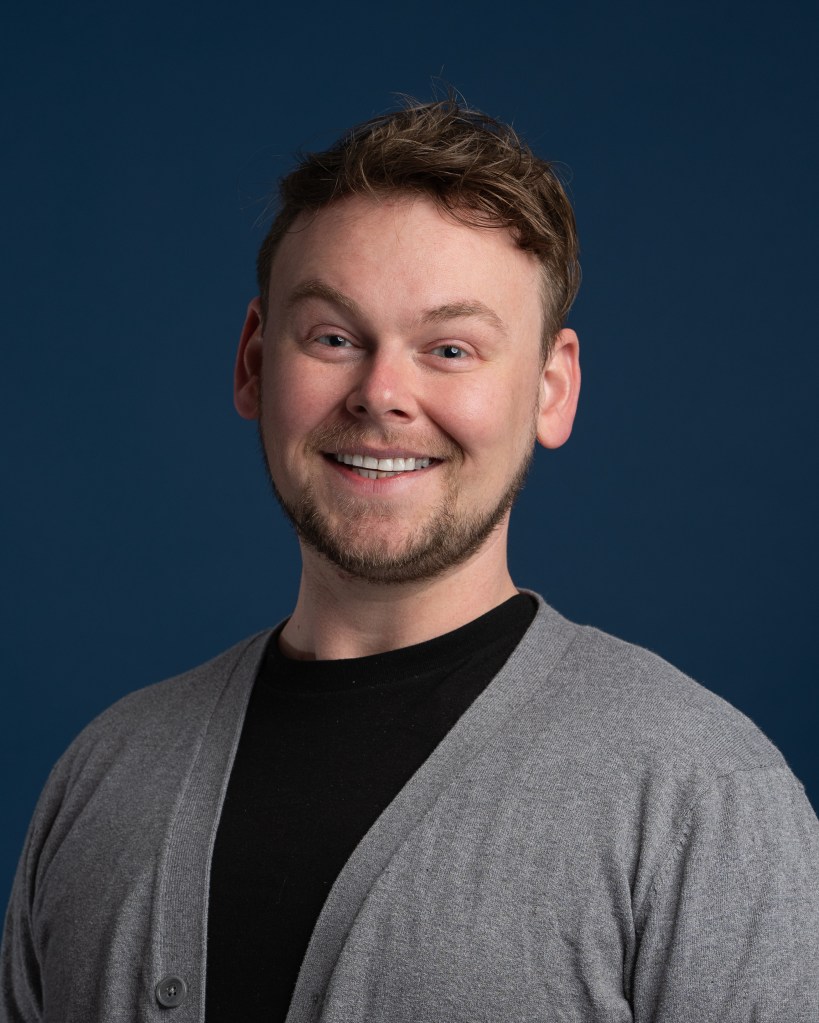
Hi, I’m Patrick.
Nice to meet you.
My journey to this work began with ink-stained fingers and half a grapefruit.
I was four years old, sitting next to my grandma at the kitchen table. She ate her grapefruit with no sugar. I ate mine with enough sugar to feed a small town. Between bites, she helped me read the high school paper — pointing at words, sounding them out, making meaning of them together. I’d reach over and grab her copy of the Chicago Tribune, too. I thought it made me older. What I didn’t know then was that the stickiness of the sugar and grapefruit juice on my fingers would make the ink from those pages not just stick for a moment, but leave an imprint that would last for decades.
That’s where it started. A kitchen table. A grandma. And the news.
I grew up loving media in the way that some kids love sports — completely, indiscriminately, and with an intensity that confused the adults around me. Horror films. Disney. 90s pop and heavy metal in the same playlist. Teen movies I have seen more times than I will admit publicly. The news. I was not a passive consumer of any of it. I was always asking why it was made, who made it, who it was made for, and what it was teaching me about the world.
It took me a long time to realize that those questions were a research agenda.
A third-grade teacher saw something in me first — named what I could become before I had the language for it. Journalism gave me a second classroom: a public one, where I learned to teach by making the process visible and accountable. By the time I was advising high school student journalists, I understood something that most journalism education ignores: the classroom and the newsroom are the same room. Both are places where people learn what counts as truth, whose voice matters, and what the institution is willing to protect.
I spent nearly a decade teaching high school journalism before entering academia. Those years shaped me in ways a Ph.D. program never could. I watched students discover their voice and lose it. I watched them ask hard questions about their communities and get told, gently, to soften them. I watched journalism education reproduce journalism’s worst habits — its hierarchies, its silences, its performance of neutrality — without anyone naming what was happening.
That is the disillusionment, if there was one. Not a single dramatic moment. A slow accumulation of noticing. Journalism talks endlessly about accountability and almost never applies it to itself. It talks about trust as something the public owes the press, not something the press has to earn. It teaches young journalists to see the world clearly and gives them almost no tools to see their own institution the same way.
So that became my work: building those tools.
I’m an Assistant Professor of Journalism at Marquette University, a newsroom and instructional coach, and a public scholar. My research moves across two interconnected areas. The first asks what it would mean for journalists to be genuinely literate about the institution they work inside — to think critically about journalism the way they are trained to think critically about everything else. The second asks what it means to be seen by journalism, and what it costs: how news systems represent queer life, how they handle harm, how they remember and forget, and what repair might require.
Being queer shaped how I see institutions long before I had the theoretical vocabulary for it. When you exist at the margins of what an institution considers normal, you develop a particular skill for reading the gap between what it says and what it does. That skill is at the center of everything I study.
I am also, always, the kid at the kitchen table — asking why the story was told this way, what the ink is actually made of, and whose fingers are allowed to get stained by it.
My scholarship has appeared in Journalism Studies, Digital Journalism, the Journal of Media Ethics, Communication, Culture and Critique, and the Journal of Media Literacy Education, among others. I am co-author of Equitable Media Literacies: Pedagogies and Practices for Healthy Civic Futures (Routledge, 2025) and have two books under contract: Journalism, Media, and Communication Pedagogy (Palgrave, 2027) and Engaged Learning in Action (Rowan & Littlefield, 2027). As a Research Affiliate with Trusting News and the Center for Information, Technology, and Public Life at UNC Chapel Hill, I work directly with journalists and news organizations to translate research into practice.
I also write publicly about journalism — its habits, its choices, and what it teaches itself to see.
How Journalism Thinks
A newsletter about journalism and the choices that shape the work — covering trust, authority, accountability, and what happens when journalism looks honestly at itself.
My public writing has also appeared in the Milwaukee Journal Sentinel and Journalism.co.uk. I produce the student podcast Ink & Airwaves with my students at Marquette.
I write about journalism’s aspirations because I still have them. I write about its failures because people live inside them.
Work with me
I work with newsrooms, journalism programs, school districts, and organizations on curriculum development, instructional coaching, trust-building practices, and media literacy education. If you’re building something that needs both the research and the room — let’s talk.
When I’m not being a teacher/scholar
In my free time, I probably can be found reading random works of narrative nonfiction, watching way too many horror films (or rewatching countless Disney or 90s/00s teen movies), being inundated with the news, making fun of and commenting about politics, consuming far too much pop culture on social media, getting way too involved in college football and basketball, and bouncing around and singing to whatever song ends up playing on my Apple Music (which usually is a healthy dose of today’s top hits, 90s/00s hits, grunge, classic rock, heavy metal, and show tunes).
What I’m doing currently
Assistant Professor | Marquette University
Research Affiliate | Trusting News
Research Affiliate | Center for Information, Technology, and Public Life at the University of North Carolina at Chapel Hill
Research Team | Mapping Impactful Media Literacy Practices Project
What I used to do
Iowa Experiences
Managing Editor | Journal of Communication Inquiry | School of Journalism and Mass Communication
Inaugural Easton Graduate Teaching Fellow | School of Journalism and Mass Communication
Graduate Instructor | School of Journalism and Mass Communication
Digital Studio Fellow | Digital Scholarship and Publishing Studio
(Summer 2022)
Research Assistant | School of Journalism and Mass Communication
(Summer 2021; Summer 2022)
Public Humanities Fellow | Obermann Center for Advanced Studies
(Summer 2021)
Additional Teaching Experiences
English and Media Teacher & Media Adviser | Antioch Community High School
(2013-2020)
Adjunct Professor of Journalism and Media Studies | Marquette University
(2013-2020)
Additional Relevant Professional Experiences
Instructor, Iowa Summer Journalism Workshop | Iowa School of Journalism and Mass Communication
(2023)
Ethics Research Intern | Storyfit: AI for the Entertainment Industry
(Winter 2020)
Director, Summer Journalism Workshop | Kettle Moraine Press Association
(2011-2020)
Instructor, Urban Journalism Workshop | Diederich College of Communication
(2011-2013)
Awards
Davis Ethics Outstanding Dissertation Award • 2024
Pennsylvania State University
Association for Education in Journalism and Mass Communication (AEJMC)
Media Ethics Division
Carl J. Nelson Memorial Research Award • 2024
School of Journalism and Mass Communication
University of Iowa
AEJMC Promising Professor Award • 2023
Association for Education in Journalism and Mass Communication (AEJMC)
Mass Communication and Society Division
Newspaper and Online News Graduate Student Research Award ($1,000) • 2023
Association for Education in Journalism and Mass Communication (AEJMC)
Newspaper and Online News Division
John F. Murray Outstanding Doctoral Student – Research • 2023
School of Journalism and Mass Communication
University of Iowa
Outstanding Teaching Assistant Award • 2023
University of Iowa
Michael Hoefges Graduate Student Research Award ($500) • 2023
Association for Education in Journalism and Mass Communication (AEJMC)
Law and Policy Division
Post-Comprehensive Research Fellowship • 2023
Graduate College
University of Iowa
Top Student Paper • Second Place Moeller Student Paper Competition • 2021
Association for Education in Journalism and Mass Communication (AEJMC)
Mass Communication and Society Division
John F. Murray Outstanding Doctoral Student – Research • 2022
School of Journalism and Mass Communication
University of Iowa
Top Student Paper • 2021
Association for Education in Journalism and Mass Communication (AEJMC)
LGBTQ Interest Group
Hugh Vollrath Ross Scholarship • 2021
Graduate College
University of Iowa
Outstanding Graduate Student • 2013
Diederich College of Communication
Marquette University
Education
Ph.D. | Mass Communication, May 2024
The University of Iowa, School of Journalism and Mass Communication
Advisor: Dr. Melissa Tully, Professor of Journalism
MA | Communication, May 2013
Marquette University, Diederich College of Communication
Thesis: The Impurity Truth: How Popular Media Taught Millennial Males to Get Laid and “Do It” as Early as Possible
Advisor: Dr. Bonnie Brennen, Professor Emerita and Nieman Professor of Journalism
BS/BA | Secondary Education and Journalism, June 2011
Marquette University, College of Education
 Patrick R. Johnson, Ph.D., MJE